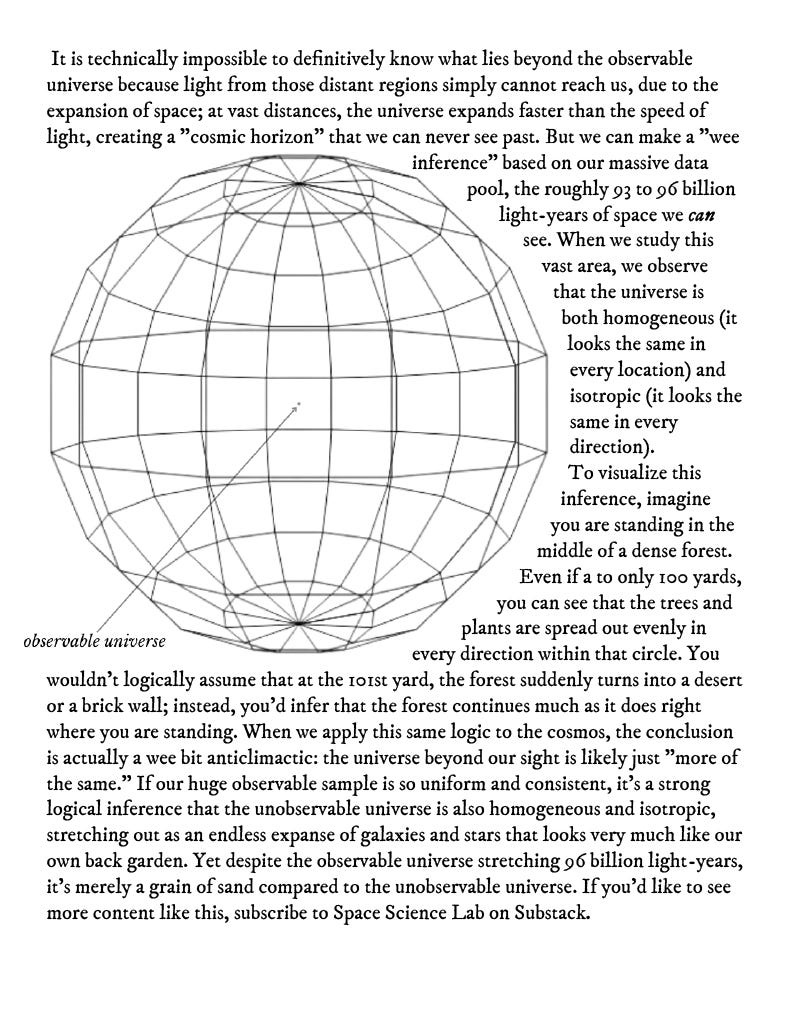
This wee dot is the observable universe.
Yes, that tiny dot.

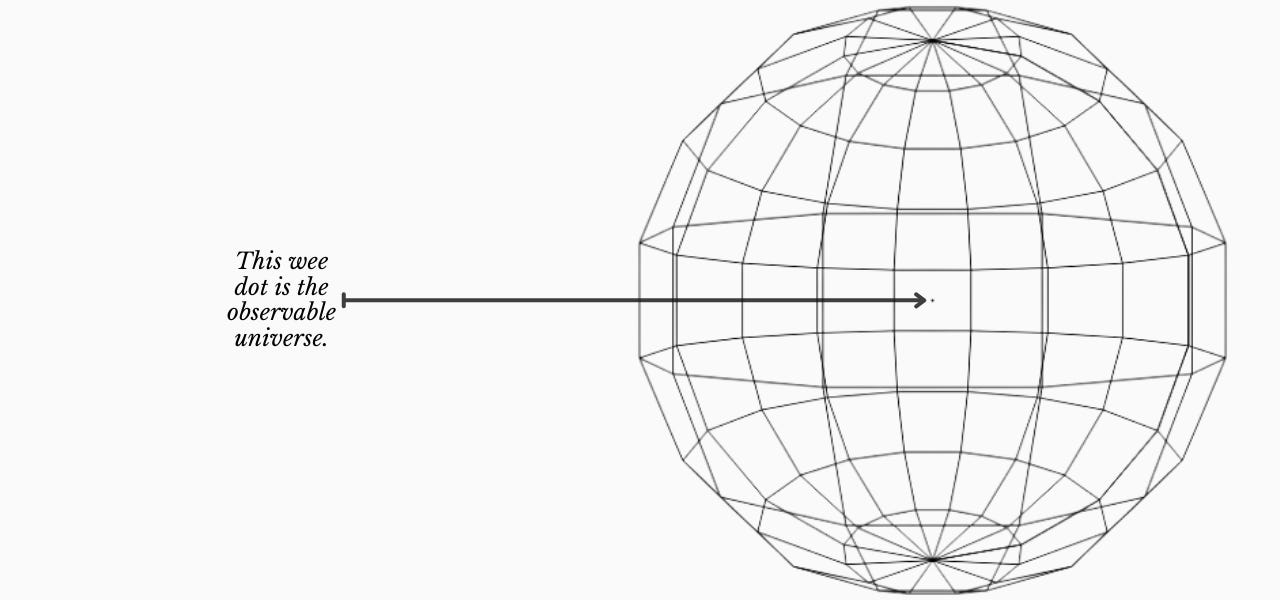
It is technically impossible to definitively know what lies beyond the observable universe because light from those distant regions simply cannot reach us, due to the expansion of space; at vast distances, the universe expands faster than the speed of light, creating a “cosmic horizon” that we can never see past.
But we can make an inference based on our massive data pool, the roughly 93 to 96 billion light-years of space we can see. When we study this vast area, we observe that the universe is both homogeneous (it appears the same at every location) and isotropic (it appears the same in every direction).
To visualize this inference, imagine you are standing in the middle of a dense forest. Even if fog limits your vision to only 100 yards, you can see that the trees and plants are spread out evenly in every direction within that circle.
You wouldn’t logically assume that at the 101st yard, the forest suddenly turns into a desert or a brick wall; instead, you’d infer that the forest continues much as it does right where you are standing.
When we apply this same logic to the cosmos, the conclusion is actually a wee bit anticlimactic: the universe beyond our sight is likely just “more of the same.”
If our huge observable sample is so uniform and consistent, it’s a strong logical inference that the unobservable universe is also homogeneous and isotropic, stretching out as an endless expanse of galaxies and stars that looks very much like our own back garden.
Yet despite the observable universe stretching 96 billion light-years, it’s merely a grain of sand compared to the unobservable universe.
Feel free to download this article as an image to share this fascinating inference with others.